
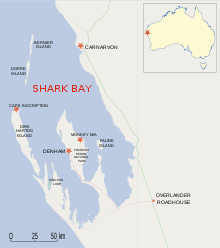
In October 2016, I sailed around Shark Bay in a small open dinghy with my long-time sailing buddy, Peter.
Here is an abbreviated history of visitors to this remote but very scenic area including our own recent visit. (For a more pictoral and less historical view, go to this version)
13.5 billion years ago
A big bang.
3.5 billion years ago
Life began and the first lifeforms to visit Shark Bay (as for much of the rest of the world) were likely cyanobacteria which accreted into a layered columnar structure called stromatolites. Like coral, but without the pretty colours.
Stromatolites proved to be pretty important because they changed the CO2-rich atmosphere of that era to the O2-rich atmosphere we have today. So technically, stromatolites were the first lifeforms to create major climate change. And they could be very useful to have around to mop up all that CO2 that we're producing now.
Sadly, there are very few stromatolites left on the planet.
20-30 thousand years ago
Aboriginals started using the area which they call Guthurraguda.
 25 October 1616
Dutchman Dirk Hartog arrived and named the area Eendrachtland (after his ship Eendracht meaning unity or union).
He also nailed an inscribed pewter plate to a post and stuck it in a rock crevice at what we today call Cape Inscription on Dirk Hartog island.
Hartog arrived at the shores of Australia by following the Brouwer route developed in 1611 which the VOC (Dutch East India Company) vessels used in order to speed their passage from Cape of Good Hope to the port of Batavia (which we now call Jakarta).
The trick with this route was knowing when to turn left because longitude could not be measured back then. Sadly, a significant number of vessels misjudged the turn-left point and crashed into Australia (e.g., Tryall 1622 (a British ship as it happens), Batavia 1629, Verguld Draek / Gilt Dragon 1656, Zutydorp 1712, Zeewijk 1727).
There were therefore a large number of visitors, some willing, some less willing, to the west coast of Australia - and all well before Cook's landing at Botany Bay in 1770.
Rather surprisingly, Shark Bay appears to have been one of the most visited spots in Australia even while it remained then as now, a rather bleak looking landscape even if blessed with plentiful wildlife and beauty. Some of the visitors following Hartog were as follows:
1618
Houtman visited Shark Bay area.Rather surprisingly, Shark Bay appears to have been one of the most visited spots in Australia even while it remained then as now, a rather bleak looking landscape even if blessed with plentiful wildlife and beauty. Some of the visitors following Hartog were as follows:
1618
1697
Vlamingh visited and happened upon Hartog's pewter plate and replaced it with one of his own and took Hartog's original plate back to Holland.
1770
Lieutenant James Cook sailed into Sting Ray Bay (which he later renamed Botany Bay) on the other side of Australia during his first voyage.
Nope, he did not sail into Shark Bay, but nor did he "discover" Australia. He wasn't the first European, he wasn't even the first Englishman.
While popular history writes it otherwise, Cook knew what was going on. On leaving New Zealand, his plan (as stated in his log) was "to steer to the Westward until we fall in with the E coast of New Holland". Cook then explored the uncharted east coast of a land long known by the Dutch and already visited some 40+ times by Europeans.
While we're correcting myths, it was Lieutenant Cook who initially explored the east coast of Australia, not Captain Cook. He was made captain on his return to England after his first voyage.
Back to visitors to Shark Bay...
1772
St Alouarn, a Frenchman, upped the ante by leaving a message in an empty wine bottle near to Cape Inscription in which he claimed the west coast of Australia for France. (He apparently never saw Vlamingh's plate).
1801
Hamelin visited the area, found Vlamingh's plate, and left it alone.
1888
Freycinet visited, found Vlamingh's plate and took it back to France
1998
Max Cramer and Philippe Godard and a small team including my long-time friend from school and son of the aforesaid Max, Kim Cramer, visited and found a coin left by St Alouarn. (The WA Museum followed up and found an empty wine bottle and another coin).
 |
| Holden & Kovesi at Cape Inscription |
October 2016
Kaptain Kovesi and First Mate Steve visit in a small open sailing dinghy named Wimbrel (4.5m / 14'9" Welsford Navigator). They had no wine nor pewter plates. And in any case, they were especially careful to remove all crockery, cutlery and other household rubbish that they had brought with them when they left. An abbreviated version of their journal follows:
Wednesday 16 October 2016
(800 km / 500 miles)
Drive from Perth to Denham towing Wimbrel.
Southbound solo cyclist sighted some 100kms south of the remote Overlander Roadhouse. Cycling into the wind along a road with no curves nor towns nor even human habitation for hundreds of kms. He was towing a baby cart loaded with all his gear.
Arrival at Denham, fresh breeze is blowing, a promising sign for our take-off tomorrow.
Last supper of fish and chips.
 Thursday, 20 October 2016
(48 kms / 17 miles)
Good wind from the south-east favouring a departure today.
Breakfast complete, itinerary logged with VMR (Volunteer Marine Rescue) and other parties, boat loaded, last photos, and we tack our way past the replicas of the Duyfken and Batavia's long-boat tied to the wharf (background of image to right). These vessels were here to commemorate the 400th anniversary of Hartog's visit.
After clearing the narrow channel, we head south-westerly towards Heirrison Prong and Bellefin Prong that define the two sides of Useless Loop.
A large fishing boat follows us for a little while, bemused at two middle-aged men cackling crazily as they hold onto the reigns (sheets and rudder) of their rearing steed.
Some whales sighted on leeward side playing and crashing around in the water, waves and wind.
We ease sheets and head downwind to steer into Tetradon Loop, our first planned stop. We skate past Notch Point (see purple line in image to left), and run into trouble with the centreboard bumping on some shallow rocks.
As we try to tack up into the bay, we find the sails are overpowered , the anchor is not holding, the recently serviced outboard is conking out, and walking the boat through the rough, rocky shallows into the wind is futile (see tangled purple line to left).
We use a scrubby bush on an otherwise bare ridge as a measure of our progress to windward. By this measure, the tree is winning and is moving ahead faster than us.
After restepping the main mast, and resetting the mizzen sail in place of the main, we tack towards an enticing sandy point which promises, albeit deceptively we discover, a long sand spit on which to land. After one false landing, we haul ourselves into a sandy cove and build Camp Crusty in the pitiful shelter of some low shrubs.
We discover one dry bag did not keep the water out, and that my mobile phone contained within that bag did not keep the water out either!
Drive from Perth to Denham towing Wimbrel.
Southbound solo cyclist sighted some 100kms south of the remote Overlander Roadhouse. Cycling into the wind along a road with no curves nor towns nor even human habitation for hundreds of kms. He was towing a baby cart loaded with all his gear.
Arrival at Denham, fresh breeze is blowing, a promising sign for our take-off tomorrow.
Last supper of fish and chips.

(48 kms / 17 miles)
Good wind from the south-east favouring a departure today.
Breakfast complete, itinerary logged with VMR (Volunteer Marine Rescue) and other parties, boat loaded, last photos, and we tack our way past the replicas of the Duyfken and Batavia's long-boat tied to the wharf (background of image to right). These vessels were here to commemorate the 400th anniversary of Hartog's visit.
After clearing the narrow channel, we head south-westerly towards Heirrison Prong and Bellefin Prong that define the two sides of Useless Loop.
A large fishing boat follows us for a little while, bemused at two middle-aged men cackling crazily as they hold onto the reigns (sheets and rudder) of their rearing steed.
Some whales sighted on leeward side playing and crashing around in the water, waves and wind.
 |
| Tetradon Loop - purple line is arriving, pale blue is walk to Herald Heights and green is departure |
As we try to tack up into the bay, we find the sails are overpowered , the anchor is not holding, the recently serviced outboard is conking out, and walking the boat through the rough, rocky shallows into the wind is futile (see tangled purple line to left).
We use a scrubby bush on an otherwise bare ridge as a measure of our progress to windward. By this measure, the tree is winning and is moving ahead faster than us.
 |
| The way back from Herald Heights - straight ahead |
Friday 21 October 2016
(14km / 9m - walking)
(14km / 9m - walking)
A good southerly wind again today, but today is for hiking to Herald Heights which is above the cliffs on the other side of Hartog Island looking out across the Indian Ocean.
We cross a Mars-like landscape, half a dozen large sand dunes, then a walk up a rutted sandy/limestone slope covered in shells a hundred metres above sea level. Whether the shells are there by wind, ancient sea levels, land-snails, who knows. From the top (~200m), we see sailing boats out in the Indian Ocean making their way to Denham around the northern tip of Dirk Hartog island.
On returning to Camp Crusty, a plan to swim in the deep dropoff from the sandy point where we landed yesterday is modified after sighting a 2m shark.
Saturday 22 October 2016
We cross a Mars-like landscape, half a dozen large sand dunes, then a walk up a rutted sandy/limestone slope covered in shells a hundred metres above sea level. Whether the shells are there by wind, ancient sea levels, land-snails, who knows. From the top (~200m), we see sailing boats out in the Indian Ocean making their way to Denham around the northern tip of Dirk Hartog island.
On returning to Camp Crusty, a plan to swim in the deep dropoff from the sandy point where we landed yesterday is modified after sighting a 2m shark.
 |
| Spot the stingray |
We depart on falling tide pushed along by about 10kts of breeze from SE past tiny Egg Island featuring a little sand dune.
Heading north past Quoin Bluff, at the northern end of the bay, we paddle over a magnificent coral reef, and cool down by standing in water knee deep holding the boat beside us in the shade of her sails. We find ourselves in a swim-by aquarium: various rays from small to enormous, mini-sharks, skates, turtles, schools of fish including one small stone-fish in the shallows of the beach.
In the afternoon, a very light breeze takes us to Louisa Bay at sunset.
The Milky Way is clearly visible in the nightsky plus two other clouds (galaxies?) to the south of the Milky Way.
Hear rhythmic thumping later that night which sounds like fireworks. Celebration in Denham? Military exercises?
Heading north past Quoin Bluff, at the northern end of the bay, we paddle over a magnificent coral reef, and cool down by standing in water knee deep holding the boat beside us in the shade of her sails. We find ourselves in a swim-by aquarium: various rays from small to enormous, mini-sharks, skates, turtles, schools of fish including one small stone-fish in the shallows of the beach.
The Milky Way is clearly visible in the nightsky plus two other clouds (galaxies?) to the south of the Milky Way.
Hear rhythmic thumping later that night which sounds like fireworks. Celebration in Denham? Military exercises?
 |
| Thump, thump, thump |
The nightlong thumping is explained at sunrise. From the tent, whales can be seen slapping their flukes on the water. The sound it makes is a muffled boom.
Tacking upwind against a northerly, past an unnamed sand spit featuring a rookery of birds, and round a bleak rocky point a little farther north called Withnell Point. Dunno what Withnell did wrong to have this godforsaken landscape named after him/her.
Set up camp in front of five distinctive bushes visible on the beach. The beach is littered with shells and many orange crabs with a single over-sized claw. The crabs are found away from the beach in the salt marsh behind the beach and even among and up in the scrubby bushes up on Withnell Point.
A small motor boat arrives and anchors for the night but they remain aboard, we remain ashore.
 |
| Flotilla amassing at Turtle Bay |
Favourable wind has us reaching the end of Hartog Island alongside a pod of whales going the same way.
Sail into Turtle Bay where just two other boats are moored, but others start arriving through the afternoon.
A challenging surging wave hampers our efforts to offload equipment to set up Camp Crusty.
Climb up sand dune to the top of cliffs for an awesome view down to the bay watching whales swim past, boats arriving.
Wind shifts to southerly, so we make a quick break out past Cape Inscription to the Indian Ocean. Wimbrel performs well and the crew hoop and holler as she rides the wind and surfs the big swells
Back at Turtle Bay, the Duyfken arrives along with other boats including Mike and Penny in a Hartley 16 Rapscalion.

Today, there are 17 boats moored in Turtle Bay including the replica of the Batavia's 9m longboat that once made the trip from the Abrolhos islands (off Geraldton) to Jakarta after the Batavia shipwreck in 1629.
At Cape Inscription, a crowd of 200 to 300 people have gathered to listen to speeches and enjoy Dutch apple cake and koekjes (the origin of our English word, cookies).
The event is historically notable not just for being the 400th anniversary of Hartog's visit, but probably representing the first time that so many people have gathered at Cape Inscription!
 |
| A crowd at Cape Inscription (@sebbyhartog) |
Wednesday 26 October 2016
Strong SE winds in the morning forestall any plans of sailing on. The combined crews of Wimbrel and Rapscalion walk southwards to the sand-spit featuring a bird rookery. The bay is surprisingly big, well-sheltered, and filled with animals - sharks, turtles, rays.
Strong SE winds in the morning forestall any plans of sailing on. The combined crews of Wimbrel and Rapscalion walk southwards to the sand-spit featuring a bird rookery. The bay is surprisingly big, well-sheltered, and filled with animals - sharks, turtles, rays.
After walk back to Withnell Pt, decision is made to sail boats down to No Name Bay which is windy, but better protected and offers the congeniality of sharing some drinks and nibbles on the beach.
Thursday 27 October 2016
More SE winds. We beat upwind bound for Louisa Bay - long way away!
As we arrive, a convoy of 4WDs arrive and drive to the southern point and round up like a circle of settler wagons. Then, a couple of drones appear and whiz along the beach and the cape - saves them walking presumably, The pow-wow of 4WDs unwinds and they drive off to the south leaving us in peace.
As we arrive, a convoy of 4WDs arrive and drive to the southern point and round up like a circle of settler wagons. Then, a couple of drones appear and whiz along the beach and the cape - saves them walking presumably, The pow-wow of 4WDs unwinds and they drive off to the south leaving us in peace.
Friday 28 October 2016
 |
| A straight line - albeit very wet |
Denham is reached on essentially one tack. As it was hard on the wind, it looks much easier on the track (a straight line) than it was.
Boats are trailered, crews are showered, the road is hit.
A night spent at the local pub and caravan park in Northampton.
Saturday 29 October 2016
Early start, big breakfast on foreshore of Geraldton and arrive in Perth in the afternoon. By this time 400 years ago, Hartog was still sailing making his way towards the port of Batavia (Jakarta) which he reached in December.
Early start, big breakfast on foreshore of Geraldton and arrive in Perth in the afternoon. By this time 400 years ago, Hartog was still sailing making his way towards the port of Batavia (Jakarta) which he reached in December.

1 comment:
What a great story to read to ring in the New Year...your adventures and misadventures made me laugh and are wetting my appetite to "get out there"after being back in New England for only one month. Funny isn't it that history suggests Cook as the "Discoverer"...much like Columbus in 1492...we all know St. Brendan and the Irish were here first...right? Slainte.
Post a Comment